
Commercial real estate is no longer just a playground for giant corporations and institutional investors. In recent years, everyday investors have started paying serious attention to business properties aggr8investing, a structured investment philosophy that prioritizes income, stability, and disciplined analysis over hype or speculation. Rather than chasing quick flips, this approach focuses on how business properties actually perform in real economic conditions.
If you’ve ever wondered how investors build steady rental income from office buildings, retail centers, industrial warehouses, or mixed-use developments, this is where it starts. Business properties aggr8investing is best understood as a methodology: combine data, patience, and risk management to make commercial property work as a long-term wealth engine.
At its core, business properties aggr8investing is about understanding how commercial assets generate income, reading market signals accurately, and building a portfolio that grows over time while staying resilient during market shifts. In today’s environment of inflation pressure, higher interest rates, and changing work habits, this structured approach matters more than ever.
Understanding Business Properties in Modern Investing
Business properties, often referred to as commercial real estate, are assets used for business activity rather than personal living. Common categories include office buildings, retail plazas, industrial warehouses, healthcare facilities, hospitality assets, and mixed-use developments that blend multiple functions into one property.
What separates business properties from residential investments is how value is created and sustained. Commercial assets are evaluated primarily on income-generating potential, tenant strength, lease terms, and operational efficiency. A single high-quality tenant with a 5–10 year lease can provide predictable cash flow that residential investors rarely experience.
Within the business properties aggr8investing framework, the focus goes beyond “buying a building.” Each property is viewed as part of a broader strategy that considers location fundamentals, tenant demand, lease durability, and long-term relevance in the local economy.
Why Aggr8Investing Emphasizes a Data-Driven Approach
A defining feature of business properties aggr8investing is its commitment to data over emotion. Successful commercial investors rely on measurable indicators rather than market noise.
Key data points typically include:
- Local employment growth and business formation
- Vacancy and absorption rates by property type
- Historical rental income and renewal trends
- Operating expense ratios and net operating income (NOI)
- Cash-on-cash return under conservative assumptions
For example, an office building located in a district with growing employment and limited new supply will generally outperform a similar building in an area with declining job numbers. Investors using business properties aggr8investing analyze these signals before committing capital.
Understanding core metrics like cap rate, NOI, and cash flow is essential. High-authority educational resources such as Investopedia break down how these metrics are used to evaluate income-producing property in a clear, non-speculative way, which aligns closely with this strategy’s philosophy.
Core Principles Behind Business Properties Aggr8Investing
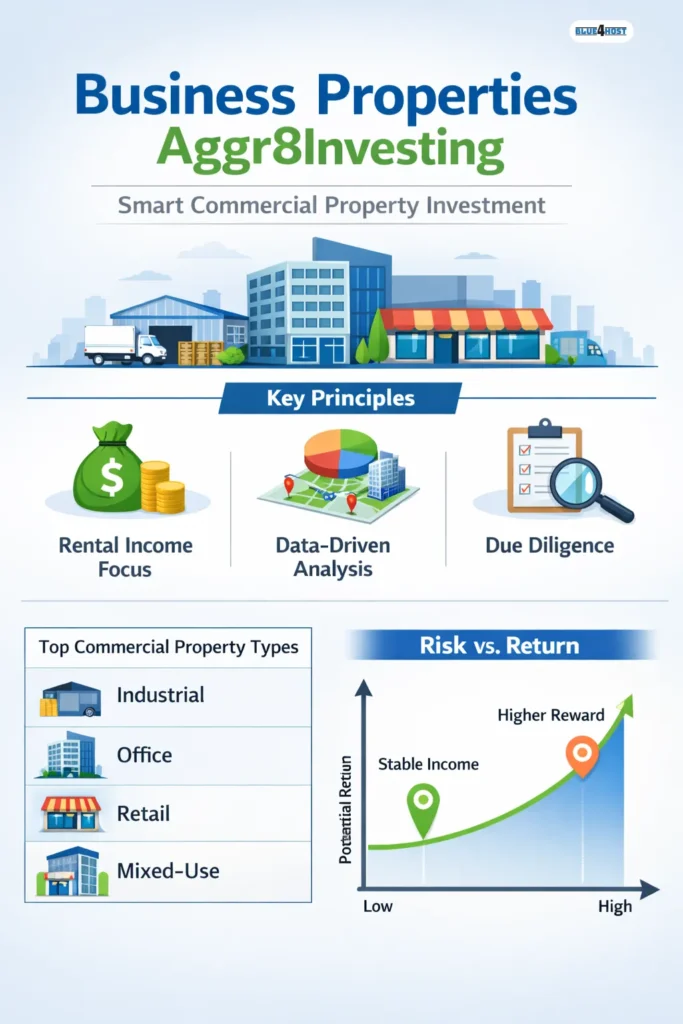
Although property types and markets vary, the strategy itself rests on a few consistent principles.
Focus on Rental Income First
Appreciation is a bonus, not the foundation. Reliable rental income allows investors to weather downturns and reinvest consistently.
Portfolio Diversification
Spreading capital across different property types and locations reduces dependency on any single tenant or sector.
Strong Lease Structures
Longer leases, creditworthy tenants, and built-in rent escalations protect income and reduce volatility.
Operating Expense Discipline
Ignoring expenses is one of the fastest ways to destroy returns. Taxes, insurance, maintenance, and management must be modeled realistically from day one.
These principles create a framework for steady growth rather than speculative gains.
Market Trends Shaping Commercial Property Today
Commercial real estate has evolved significantly, and business properties aggr8investing adapts to these shifts instead of resisting them.
One major trend is the flight to quality. Tenants increasingly prefer modern, efficient buildings in strong locations, even if it means occupying less space. This has benefited well-located assets while pressuring outdated properties.
Another trend is the continued growth of industrial and logistics real estate, driven by e-commerce and supply chain restructuring. Warehouses near population centers have seen strong demand relative to many other sectors.
Mixed-use developments have also gained momentum as cities prioritize walkable environments where people can work, shop, and access services in one place. These properties often show more stable occupancy because they serve multiple demand drivers.
At the same time, higher interest rates have made underwriting discipline more important. Investors following business properties aggr8investing adjust return expectations and focus on realistic cash flow rather than aggressive leverage.
Due Diligence: Where Smart Investors Win or Lose
If there is one stage that defines success or failure, it is due diligence. This is where business properties aggr8investing clearly separates disciplined investors from gamblers.
A thorough due diligence process includes:
- Verifying tenant financial health and payment history
- Reviewing historical income statements and rent rolls
- Inspecting physical condition and deferred maintenance
- Confirming zoning, permits, and legal compliance
- Analyzing operating expenses for consistency and risk
Skipping or rushing this step often leads to unpleasant surprises after closing. Experienced investors understand that a deal that looks attractive on the surface can quickly unravel under closer inspection.
Business Properties vs Residential Property Investing
Many investors begin with residential property before transitioning into commercial assets. Understanding the differences helps clarify why business properties aggr8investing appeals to those seeking scale and predictability.
| Factor | Residential Property | Business Properties |
|---|---|---|
| Typical Lease Length | 6–12 months | 3–10+ years |
| Tenant Type | Individuals | Businesses |
| Income Stability | Moderate | Higher with strong tenants |
| Valuation Basis | Comparable sales | Income (NOI) |
| Management Intensity | Higher turnover | Lower turnover |
Commercial investments require stronger analysis and patience, but they often reward investors with more stable income and clearer performance metrics.
Which Commercial Property Is Best to Invest In?
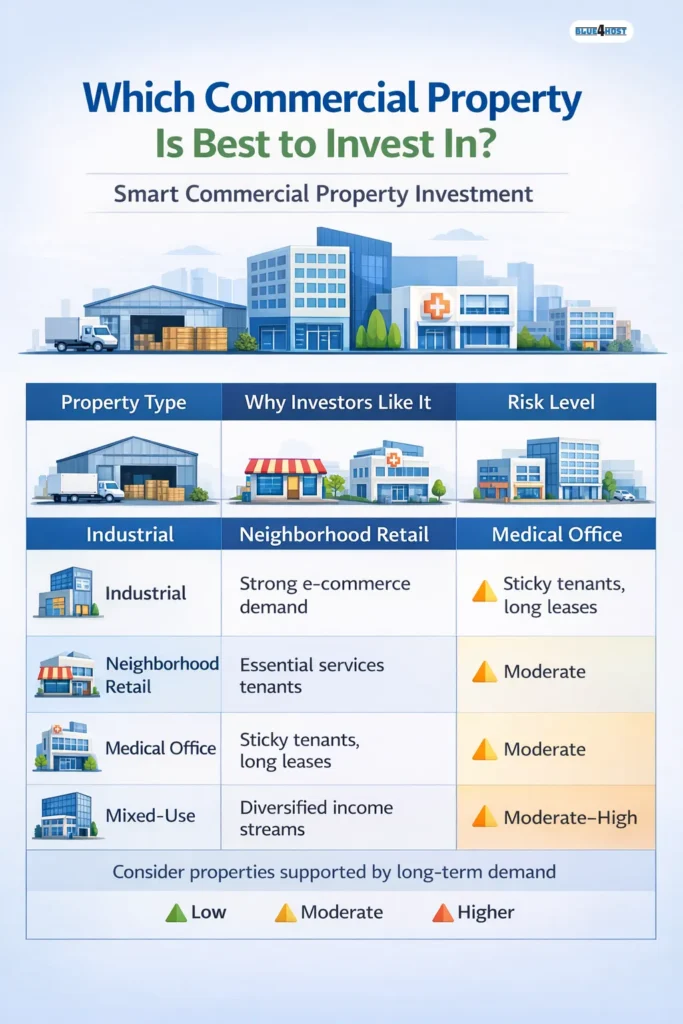
This is one of the most common questions new investors ask, and the honest answer is: it depends on your goals, risk tolerance, and market knowledge.
Within business properties aggr8investing, the “best” commercial property is typically one that balances demand stability with manageable complexity.
| Property Type | Why Investors Like It | Risk Level |
|---|---|---|
| Industrial/Warehouse | Strong e-commerce demand | Low–Moderate |
| Neighborhood Retail | Essential services tenants | Moderate |
| Medical Office | Sticky tenants, long leases | Moderate |
| Mixed-Use | Diversified income streams | Moderate–High |
| Traditional Office | Potential upside, selective | Higher |
Rather than chasing trends, this strategy emphasizes choosing assets supported by long-term economic drivers.
What Are the 7 Main Investment Types?
In commercial real estate, investors typically encounter seven broad property categories:
- Office
- Retail
- Industrial
- Multifamily (apartment buildings)
- Hospitality
- Healthcare
- Mixed-use
Business properties aggr8investing doesn’t claim one category is universally superior. Instead, it encourages investors to understand how each type behaves across economic cycles and how it fits into a diversified portfolio.
Which Property Is Best for Investment Overall?
From a practical standpoint, the “best” property is one that aligns with three factors: predictable income, sustainable demand, and manageable risk. For many investors, this often points toward industrial assets, necessity-based retail, or well-located mixed-use properties.
The key lesson from business properties aggr8investing is that consistency usually beats complexity. A simpler property with reliable tenants often outperforms a flashy asset with unstable income.
Balancing Risk While Growing Returns
Every investment carries risk, but commercial property allows risk to be managed strategically. Diversifying across locations, tenant industries, and property types reduces exposure to any single shock.
Using conservative underwriting assumptions, stress-testing cash flow, and focusing on realistic cash-on-cash returns helps protect capital. Investors who chase overly optimistic projections often miss warning signs such as rising operating expenses or softening tenant demand.
Sustainable returns, not perfection, are the goal.
Practical Tips for Getting Started
If you’re new to business properties aggr8investing, these habits can make a real difference:
- Invest in education before deploying capital
- Track market data regularly, not occasionally
- Favor income-producing assets over speculation
- Never compromise on due diligence
- Reinvest cash flow to compound growth
These practices reduce emotional decisions and build confidence over time.
Final Thoughts: Why Business Properties Aggr8Investing Makes Sense
Business properties aggr8investing is not about shortcuts or hype. It’s about clarity, structure, and patience. By focusing on income-driven commercial property, disciplined analysis, and realistic expectations, investors can build portfolios designed to perform across market cycles.
Whether you’re transitioning from residential property or entering commercial real estate for the first time, this approach provides a framework grounded in real-world fundamentals. In an era defined by uncertainty, strategies that prioritize rental income, diversification, and data-driven decision-making offer a powerful foundation for long-term wealth.
Visit our website: Blue4Host