
Intraday trading, also known as day trading, is one of those things people talk about a lot but truly understand very little. You’ll hear stories of quick profits, screenshots of green numbers, and bold claims floating all over the internet. When people search for profitable intraday trading advice 66unblockedgames.com, they’re often not just looking for charts or indicators — they want clarity. What works, what doesn’t, and how not to blow up an account in a single bad decision.
This guide is written for that exact reason. No hype, no unrealistic promises. Just grounded, experience-based insight into how intraday traders actually approach the market, manage risk, and survive bad trades long enough to become profitable.
What Intraday Trading Really Is
Intraday trading, or day trading, means you buy and sell stocks within the same trading session. No overnight positions, no hoping tomorrow fixes today’s mistakes. Every trade is closed before the market ends, profit or loss.
The appeal is simple:
- Faster feedback on decisions
- More trading opportunities during market hours
- No overnight news or gap risk
But the downside is just as real. Intraday trading demands focus, emotional control, and a clear plan. Without those, it becomes expensive very fast.
Many beginners assume intraday trading is about constant action. In reality, professional day traders often wait hours for one or two high-quality setups. Patience is part of the edge.
Why Most Intraday Traders Struggle
Here’s an uncomfortable truth: most intraday traders lose money, especially in their first year. Multiple market studies estimate that 80–95% of active day traders fail, not because the market is unfair, but because fundamentals are ignored.
Some common reasons:
- No written risk management plan
- Oversized positions relative to account size
- Chasing trades emotionally after missing entries
- Refusing to accept a losing trade
A single bad trade can erase a week of profits if position sizing is ignored. That’s not theory — that’s what actually happens in live markets.
Typical Beginner Errors vs Professional Habits
| Beginner Behavior | Professional Approach |
|---|---|
| Trades without a plan | Trades only pre-defined setups |
| Risks large to “make it worth it” | Risks small to stay consistent |
| Moves stop loss | Accepts stop loss instantly |
| Focuses on daily profit | Focuses on execution quality |
This difference in behavior is why profitable intraday trading advice focuses more on discipline than indicators.
Profitable Intraday Trading Advice That Actually Matters
Let’s talk about what separates consistently profitable traders from everyone else. These principles show up again and again in credible resources discussing profitable intraday trading advice 66unblockedgames.com, and for good reason.
1. Risk Management Comes Before Profit
If there’s one concept you should tattoo on your trading brain, it’s risk management. Profits are optional. Survival is not.
Professional intraday traders define risk before entering a trade:
- How much they can lose per trade
- Where the trade idea becomes invalid
- How many losing trades they can handle in a row
A common guideline is risking 1% or less of total capital per trade. This allows traders to withstand normal losing streaks without emotional damage.
This also answers a common question people ask: Can I earn $1000 daily in intraday?
Technically yes, but only with a large account, years of experience, and strict risk control. For most traders, chasing a fixed daily income target leads to overtrading and poor decisions.
2. Position Sizing Is Not Optional
Position sizing answers one critical question: How many shares should I trade?
It depends on three variables:
- Account size
- Stop loss distance
- Maximum risk per trade
Here’s a simplified example:
| Account Size | Risk per Trade (1%) | Stop Loss | Position Size |
|---|---|---|---|
| $5,000 | $50 | $0.50 | 100 shares |
| $10,000 | $100 | $1.00 | 100 shares |
| $25,000 | $250 | $0.50 | 500 shares |
When position sizing is correct, even a losing trade feels controlled instead of stressful. This is one of the most practical pieces of profitable intraday trading advice beginners ignore.
Always Set a Stop Loss Order
If you don’t set a stop loss order, you are not trading — you are hoping.
A stop loss:
- Protects your capital
- Removes emotional decision-making
- Keeps losses small and predictable
Many traders avoid stop losses because “price might come back.” Sometimes it does. Most times it doesn’t. The market does not care about your entry price.
Successful intraday traders accept small losses quickly so winners can compound over time.
How Intraday Traders Buy and Sell Stocks
Intraday traders don’t randomly click buttons. Trades are based on structure and confirmation.
They look for:
- Clear intraday trends
- High relative volume stocks
- Defined support and resistance levels
The idea is simple: buy strength, sell weakness, and exit fast when wrong.
Using Moving Averages the Right Way
Moving averages are one of the most commonly used tools in day trading — and one of the most misunderstood.
Intraday traders use them to:
- Identify trend direction
- Spot dynamic support or resistance
- Avoid trading against momentum
Common combinations include:
- 9 EMA & 20 EMA for short-term momentum
- 50 EMA for overall intraday trend
This also answers another common question: Which is the no. 1 indicator for intraday?
There isn’t one. Indicators support decisions, they don’t replace risk management or market context. Many professionals rely more on price action and volume than any single indicator.
Understanding the 3-5-7 Rule in Day Trading
The so-called 3-5-7 rule is often misunderstood. It generally refers to trade management principles, not guaranteed profits:
- 3% maximum risk per day
- 5% maximum risk per trade (often much lower for professionals)
- 7% maximum weekly drawdown before stepping back
The idea is simple: protect capital by setting loss limits that force discipline. Traders who respect these limits survive longer and learn faster.
Common Mistakes That Destroy Accounts
Even experienced traders fall into these traps sometimes. Beginners fall into them daily.
Overtrading
More trades don’t mean more money. Often it means more fees, more stress, and lower-quality setups.
Revenge Trading
One losing trade leads to emotional decisions trying to “get it back.” This usually ends with a bigger loss.
Ignoring Market Conditions
Some days trend cleanly. Some days chop sideways. Forcing trades on low-quality days drains accounts.
Holding Losing Trades Too Long
A losing trade should be boring and quick. The longer you hold it, the more damage it does — financially and mentally.
Pros and Cons of Intraday Trading
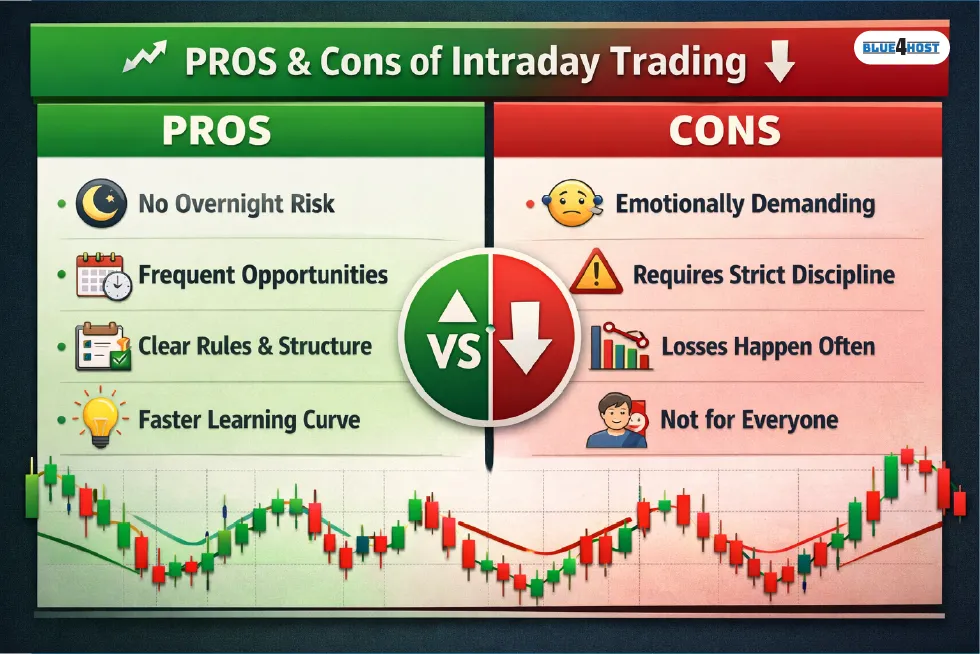
| Pros | Cons |
|---|---|
| No overnight risk | Emotionally demanding |
| Frequent opportunities | Requires strict discipline |
| Clear rules and structure | Losses are frequent |
| Faster learning curve | Not suitable for everyone |
Intraday trading is a skill, not a shortcut.
FAQ’s
While it’s theoretically possible, making $1000 a day consistently is challenging and requires significant capital, a solid strategy, and risk management. Most traders focus on consistency and growth rather than aiming for large daily profits.
The 3-5-7 rule is a simple method to control risk and avoid emotional trading. It involves:
3: Never risk more than 3% of your account balance on any trade.
5: Stick to five trades per day, focusing only on the most promising opportunities.
7: Aim for seven trades in a week, giving you enough time to observe market trends and avoid burnout.
There is no “one-size-fits-all” answer. The moving average is widely regarded as one of the top indicators for identifying market trends. Combining this with other tools, like volume analysis and support/resistance levels, can create a more comprehensive strategy.
Final Thoughts: What You Should Actually Take Away
If you searched for profitable intraday trading advice 66unblockedgames.com, the real value isn’t in the keyword — it’s in the discipline behind profitable trading.
Remember this:
- Protect capital before chasing profit
- Use proper position sizing
- Always set a stop loss order
- Accept losing trades as part of the process
- Avoid emotional mistakes that destroy accounts
Profitable intraday trading advice isn’t flashy. It’s repetitive, structured, and sometimes boring. But boring is exactly what keeps traders profitable over the long term.
Master the process first. If you do that consistently, the profits tend to follow — slowly, then steadily.
RELATED ARTICLE: FintechAsia Net and the Telekom Shift – Where Telecom Networks and Digital Finance Finally Meet